
“The author is fully conscious of his failings in the task he has undertaken; but conceiving an effort of this nature to be desirable, he commenced the attempt…” — Edwin Butterworth, “A Statistical Sketch of the County Palatine of Lancaster” (1841).
As I began my Introduction with a quotation from the preface of James Butterworth’s History of Oldham (1817), it seems appropriate to end this story with the epigraph above from the preface of one of his son’s books. Doubly appropriate in that I, too, am fully conscious of the errors, due to speculation, that I may have introduced into this history.
At the beginning of this tale I stated that my motive for delving into my family’s history (and that of my home town) was to discover more about my great grandfather, George Vinge Thomas. Throughout this narrative I’ve alluded to the stories that my father told me about his grandfather. I’ve also mentioned the fact that I can find no evidence to support these stories. What I haven’t done, however, is to explain why I think these stories arose.
One story that I do believe in connection with George was told to me by my mother who had spoken to my great uncle Joe’s widow, Esme, on the telephone. Esme had told her that after the couple had married they were living with Joe’s mother, Harriet, in Yale Street. Esme said that when Harriet died, Joe burnt all the family records and documents. I believe this is directly related to George’s death, and the need for the family to keep the details of his death a secret.
I’ve stated earlier that the first thing I did to discover more about George was to search for the record of his death, and the first documentary evidence that I obtained about him was his death certificate. This document (see below) immediately revealed the reason why Joe destroyed all the family records, and why all these stories were invented about the mysterious George Vinge Thomas.
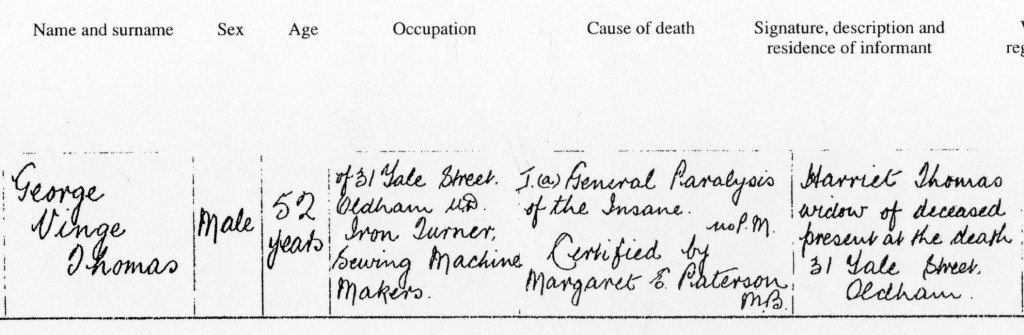
I later discovered that a month before his death, George had been admitted to the Oldham Workhouse Infirmary for “softening of the brain” (PUO/12/1/66). On admittance to the Mental Ward he was given a 14 days’ order, and 12 days later a “detention” order (PUO/12/1/93). Today we might refer to softening of the brain as dementia, and we might assume that George had suffered from early-onset Alzheimer’s; however, the use of the term “General Paralysis of the Insane” on his death certificate implied something much more uncomfortable for the Thomas family – neurosyphilis. How and when George was infected with syphilis is difficult to know. Neurosyphilis can occur at any stage of the disease, primary, secondary or tertiary; however, the neuropsychiatric symptoms (dementia, mania and delirium) are usually associated with the tertiary stage of the disease. The advanced stages may occur between 1 and 30 years after infection. As Harriet lived for another 18 years, and died of congestive heart failure, it would seem that George didn’t transmit the disease to her. So, it seems most likely that George contracted syphilis later in life, perhaps within a couple of years of his death. Alternatively, George may have acquired the disease several years before his marriage, and then entered a late, latent phase in which he was no longer infectious.
Of course, with the introduction of penicillin and other powerful antibiotics this disease is no longer fatal. Indeed, with prompt treatment, the infection would now never reach the tertiary stage. As a result, families are now protected from the stigma attached to this infection and saved the embarrassment felt by my grandfather and his siblings.
So, after almost 20 years of researching my family and their personal histories, my abiding message to other family historians is to have fun while carrying out your research, but beware of what you might find!
 oldhamthomases.uk