
“I commenced work for a firm [Hibbert, Platt & Sons] who employed near 2,000 hands, whose tools were mostly Whitworth’s make … Men in large shops are not troubled with a variety of work, but had one class of work and special tools. The men soon became expert and turned out a large quantity of work with the requisite exactness without a little of the thought required of those who work in small shops …” – Autobiography of Thomas Wood1, who worked at Hibbert, Platt & Sons in 1845-46.
What effect does technological innovation have on the labour market, and does the 1852 lock-out by machine-making companies throw an instructive light on this question? Throughout human history the invention of novel tools has had profound effects on the evolution of the species. However, it was only with the creation of machines which could do the jobs of men and women that such innovation began to disrupt the fabric of society. As long as the introduction of technology merely improved the ability of workers to carry out their work, these developments were viewed as beneficial. However, once artisans believed the new technology could directly replace them, then problems arose. So, the questions are: does the introduction of new technology lead to fewer or more jobs?; what are the effects on wages?; and does the ease of using these new methods of working lead to a loss of artisanal skills? I believe the issues surrounding the 1852 lock-out in the engineering industry show that the introduction of ‘machine tools’ led to an increase in job opportunities, but the jobs created were at a lower skill level, and consequently remunerated at a lower rate.
Luddite uprisings
Perhaps the first evidence of the effects of innovation on social order in Britain came with the introduction of mechanization in the textile industries of England in the early 19th century – ‘wide stocking frames’, ‘shearing frames’, and ‘power looms’. These new-fangled contraptions were viewed as threats to the livelihood of working people of the Midlands (stocking-makers), Yorkshire (woollen-cloth finishers) and Lancashire (cotton weavers), and led to violent actions by the workers against their masters, such as frame breaking in Nottingham, and mass attacks on mills in Lancashire and Yorkshire. The disturbances began in the Midlands, but reached their worst extent in the North with workers being shot while attacking mills in the Spen valley and Middleton, and with the execution of several of the perpetrators.2 Not long after these so-called ‘Luddite’ uprisings in the textile industry came rumblings of discontent in the engineering industry due to a depression in trade (1847-1851). The unhappiness of the skilled engineers with their working conditions resulted in numerous disputes between the engineering union (Amalgamated Society of Engineers) and employers in the North of England (1850-51). Eventually, these disagreements would culminate in the 1852 lock-out that was precipitated by unrest at the Oldham textile-machinery manufacturers, Hibbert, Platt & Sons.3
In the midst of the Industrial Revolution with the development of new machinery to make textiles, and the invention and improvement of the steam engine, which both drove these machines and increased the speed of transport, it became increasingly apparent that the number of skilled engineers available to build locomotives and make textile machinery was completely inadequate. Similarly, the time required to train such men was far too long (seven years) to keep up with the demands of these new industries. As a result, a small cohort of engineers began to think about ways in which to speed up the manufacturing process, and to improve the quality, precision and reproducibility of production of metal components.4
The birth of machine tools
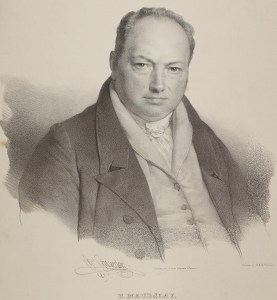
At the end of the 18th century the engineering industry was dominated by small workshops of highly-skilled men who made iron machines and their metallic components mostly by hand – any machinery used was made of wood with metal fittings, possibly driven by a treadle.5 At this time, London was the centre of the British engineering industry, and it was here that a few men would begin to develop the tools that would revolutionize the manufacture of machinery. Perhaps pre-eminent amongst these men was Henry Maudslay (see Fig. 1). This man not only invented new tools and methods of working, but also became so recognized by his peers that he acted like a magnet to other innovators throughout the country. Men such as Richard Roberts who arrived in Maudslay’s workshop from Wales via Staffordshire and Manchester; Joseph Whitworth from Stockport; James Nasmyth from Edinburgh, and William Muir from Ayrshire all of whom would eventually end up in south Lancashire.6
Woolrich argues that London became the centre of the British engineering industry around the turn of the 18th century because of the demands of a city that was the largest in the world at the time – this despite the lack of local sources of coal, iron, or water power.7 What the city had in abundance were numerous craftsmen who worked with exceptional precision: watch-makers, scientific instrument makers, locksmiths and silversmiths. Indeed, it was the need for precision and reproducibility that provided the impetus to develop new machine tools that could carry out such work with much better precision and at greater scales than could be provided by a small number of highly-skilled artisans. Such an artisan was Maudslay who had honed his skills working for the most-renowned locksmith in the country, Joseph Bramah.8
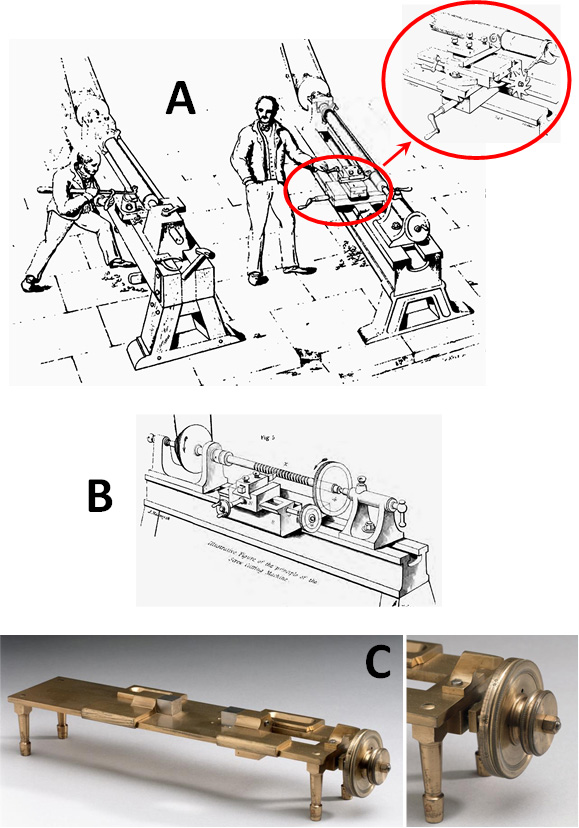
Maudslay is often credited with inventing something that is at the heart of the new ‘machine-tool era’: the metal lathe. Lathes had been around for centuries, but were generally made of wood with metal fixings. Such machines lacked the rigidity needed for precision work, and it was Maudslay’s innovations that created a lathe with the accuracy and reproducibility that became the standard in the industry. The improvements introduced by Maudslay rested on three innovations that he had already developed: one, the ability to generate truly-flat plane surfaces on metal; two, the facility to produce accurate screw threads (see Fig. 2B), and third, but not least, an improved ‘slide rest’ (see inset Fig. 2A). The slide rest was a component of the lathe that clamped the cutting tool into a fixed position. In Maudslay’s version the cutting tool could be precisely positioned (in or out) by turning one handle, and slid along the horizontal axis by turning a second handle (see Fig. 2A). This simple, but ingenious, device allowed the engineer to cut metal in a smooth continuous fashion with greater accuracy and with far less exertion than had previously been needed (cf. left and right panels of Fig. 2A). Integral to these innovations was the ability to make precise measurements, something that Maudslay enabled by making a very accurate micrometer (see Fig. 2C). Indeed, it’s difficult to see which came first – the micrometer depends upon a precisely-cut screw-thread. However, determining the accuracy of the thread requires the micrometer. Clearly, these innovations came about through an iterative process which Maudslay developed over several years; a process that he passed on to his numerous acolytes. One such man, James Nasmyth, would go on to say of Maudslay: “The indefatigable care which he took in inculcating and diffusing … sound ideas of practical knowledge and refined views of construction … render his name identified with all that is noble in the ambition of a lover of mechanical perfection.”.9
Nasmyth himself would find fame as the maker of locomotives, stationary steam engines and steam hammers at his Bridgewater Foundry in Patricroft, Salford. Nasmyth was born in Edinburgh, but moved to Maudslay’s Lambeth workshop to learn the practical methods of the renowned master engineer. He arrived in Lambeth having already constructed a full-size road steam-carriage. However, he had also made a number of model steam engines, and much of his work in his new work-place would involve draughtsmanship and model building on a very small scale. While working with Maudslay he helped to refine Maudslay’s screw-cutting machine and also devised his own ‘nut-cutting machine’ to make hexagonal nuts. Maudslay would die while Nasmyth was in Lambeth, and a few years later Nasmyth would leave the workshop to set up his own business in Lancashire, but before doing so he was allowed to take with him castings of Maudslay’s best lathes. Nasmyth then spent almost three years using these castings to develop the machine tools which he would use in starting his own business – screw-cutting machines, planing machines, and other tool-making devices. Indeed, although his main business was in steam engines, he continued to produce machine tools that he sold to other machine manufacturers. One thing that he doesn’t seem to have learnt from Maudslay was the need for precision. He seems to have had a particular dislike of another Maudslay graduate, Joseph Whitworth, who he believed was “…overly concerned with accuracy and precision.”.10
Joseph Whitworth would, indeed, make his reputation in the field of precision engineering – his name being synonymous with accuracy and reproducibility, as shown by the standard screw-thread that bears his name. While working with Maudslay, Whitworth was undoubtedly heavily influenced by his master’s demand for accuracy, and while in the Lambeth workshop appears to have improved Maudslay’s planing machine to achieve “ … a perfectly plane surface.”. Like Nasmyth, Whitworth recognized that the demand for machines in the developing textile industry of Lancashire would provide great opportunities for an engineer. On moving north, he would establish a machine-tool manufacturing business of world-renown making planing, shaping, slotting, screw-nut making and boring machines that “ … were of an amazingly high standard of accuracy, and it was his success in maintaining this standard that became Whitworth’s achievement, making his machines the best in the world.”.11
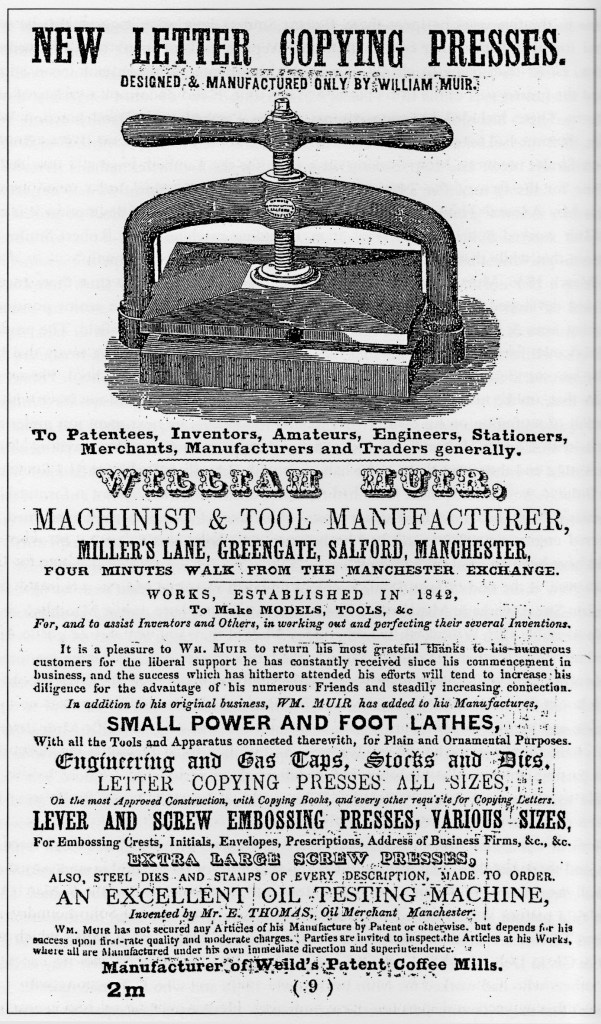
As well as Nasmyth and Whitworth, other engineers would also pass through Maudslay’s workshop. Men such as Richard Roberts who went on to found his own company in Manchester to produce innovative power looms and spinning mules, but also continued to manufacture his own machine tools.12 Likewise, one William Muir who not only worked in Maudslay’s shop, but was also Whitworth’s works manager before forming his own machine-tools manufacturing company in Salford (see Fig. 3). His company would be amongst a new generation of machine-tool makers who picked up the mantle of the early pioneers and carried it forward through the middle and late 19th century.13
These four men would be amongst many that brought the centre of the British engineering industry to Manchester. Burgess says that in 1825, 400-500 London firms employed up to 10,000 men. However by 1851, there were only 213 companies employing 6,889 men in machine and tool making in London. In contrast, there were 13,649 men similarly employed in Lancashire.14
William Fairbairn is reported to have said that when he first entered the world of mechanical engineering (c. 1800): “ … there were no self-acting tools; everything was executed by hand. There were neither planing, slotting nor shaping machines… “. And Smiles says of manual methods: “Even in the construction of comparatively simple machines, the expense was so great as to present a formidable obstacle to their introduction and extensive use;… ”. However, with the introduction of machine tools “ …all kinds of metal work could now be turned out in a quantity and at a price that, but for its use, could never have been practicable.”.15 It would be the increased use of such tools, and the employment of untrained or semi-skilled men to run the machines, that would ultimately lead to the 1852 lock-out.
Formation of the engineering unions
The fore-runner of the mechanical engineer was the ‘millwright’ who Fairbairn described as “ …to a great extent the sole representative of the mechanical art … an itinerant engineer and mechanic of high reputation.”.. And it would be in London, around 1799, that the millwrights and other mechanics would form a friendly society for their own mutual benefit which Jefferys suggests was probably called the ‘London Fellowship of Millwrights’. About 25 years later, around the time of the repeal of the Combination Acts (1824-25) in Manchester, another friendly society of engineers was formed, the ‘Journeymen Steam Engine and Machine Makers’ Friendly Society’ often referred to as the ‘Old Mechanics’. These were just two of a series of engineering unions that sprang up whose initial aims were related to social insurance, but would evolve into an aspiration to obtain better working conditions. By 1838, the Old Mechanics had grown to a membership of over 3,000 men, and was perhaps the strongest engineering society in the country. This society would be involved in a strike in Bolton in 1831 over working hours, overtime payments and the employment of too many apprentices. This dispute has clear parallels to the issues in 1851 leading up to the lock-out. Furthermore, in 1843 the Old Mechanics set up a committee to look into the “evils resulting to our trade by working systematic overtime”, and in 1845 passed a resolution that “No member of the Society to undertake piece-work under any consideration”. However, it would be the employment of large numbers of ‘illegal men’, who hadn’t undertaken an apprenticeship, which would initiate a strike at the locomotive works of Jones & Potts in Newton-le-Willows in 1846, and would spell the end of the Old Mechanics. The employers resorted to the force of law, and had several strikers as well as the General Secretary of the Old Mechanics (Henry Selsby) arrested. Despite the fact that Selsby’s conviction was quashed on appeal, the Old Mechanics ultimately withdrew from disputes between workers and their employers. As a result, there was a growing feeling amongst engineering workers that they needed more powerful representation, and that this could only come with bigger societies. Thus was born a new, nationwide organization – the Amalgamated Society of Engineers (ASE).16
The idea of amalgamation of the various engineering friendly societies was the brain-child of William Allan and William Newton; the former would become the General Secretary of the ASE, and the latter would produce a weekly journal – The Operative – which would reproduce all the policy statements of the newly-founded union, together with reports of its committee meetings. Newton would also play a pivotal role in the lead up to the lock-out, as the arbitrator between the workers and John Platt, the senior partner of Hibbert, Platt & Sons, in the dispute that would provide the spark for the lock-out.17
Systematic overtime, Piece-work and Illegal men
As we can see from the above discussions, and the quote in the epigram from Thomas Wood, the introduction of machine tools led to a situation which threatened the replacement of skilled millwrights/engineers, who would make metal components by hand (and would demand high wages), with semi-skilled men, who could be quickly trained to use a single machine, to turn out lots of identical pieces with the accuracy, precision and speed unattainable by hand. This ability to produce components faster and with superior reproducibility was at the heart of the growth in the engineering industry between 1830 and 1850, but would also present the engineering worker with the greatest challenge to his livelihood. As noted above, several strikes took place in this period. The three main issues that were raised by workers in these disputes were systematic overtime, piece-work, and the employment of men who were not apprentices or who had not undergone a seven-year apprenticeship, so-called illegal men. Systematic overtime was introduced by employers who had invested a great amount of capital in their machine tools, and so desired for them to be used as much as possible. Similarly, piece-work was seen by employers as a way to maximize profit by only paying for work done rather than time in the workplace. Finally, the ease of use of these machine tools provided another means of cost cutting, by employing unskilled or semi-skilled workers at wages much lower than those of a trained mechanic. These three issues would appear again as matters of concern in Oldham at the textile-machinery manufacturers of Hibbert, Platt & Sons in 1851.18
Hibbert, Platt & Sons19
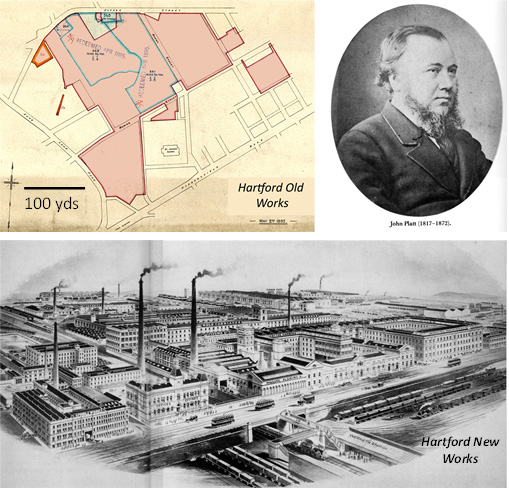
The machine manufacturers of Hibbert & Platt was established in Oldham in 1822 by Elijah Hibbert and Henry Platt, and their workshop specialized in making machinery for use in the burgeoning cotton industry. In 1829-30 they opened a purpose-built factory in Greenacres named the Hartford Works, later to become the Hartford Old Works (see Fig. 4). Between 1836 and 1841 the management of the company would be joined by Henry’s sons, Joseph, John and James, and the company would be renamed Hibbert, Platt & Sons. In 1845, the business would expand enormously with the opening of a brand-new factory in Werneth – Hartford New Works (see Fig. 4). At this point, following the death of Elijah Hibbert (1846), and the earlier deaths of his father and brother Joseph, John would become the senior partner, and the one who would deal with the threat of strikes by his workforce in 1851 (see below). In 1854, John and James would buy out the Hibbert family interest in the company and it would become Platt Brothers & Co..
For over a hundred years Platts would dominate the manufacture of cotton-spinning machinery across the globe. According to Farnie, Platt’s spinning mules “… were the true basis of industrial supremacy of Oldham, being unrivalled in length, in speed of operation, and in productivity.”. Indeed, the company would receive a special commendation from Queen Victoria when they presented their machines at the Great Exhibition in 1851.20 Perhaps most notably, Farnie says that visitors to the Platt’s factories were amazed “… by the advanced degree of mechanization of production.”. Such a statement chimes well with Thomas Wood’s observations (see above) that workmen at the firm “… soon became expert and turned out a large quantity of work with the requisite exactness …”, using machine tools manufactured by the most prestigious machine-tool manufacturer in Britain – Joseph Whitworth. During the disputes that would engulf Platts in 1851, John Platt expressed incredulity at why his firm was being singled-out by the engineering union, and received a reply to the effect that his was the largest company using the most advanced technology, and operating more machine tools than any other engineering works in the country. Clearly, being at the forefront of innovation came with its costs!
Worker militancy in Oldham
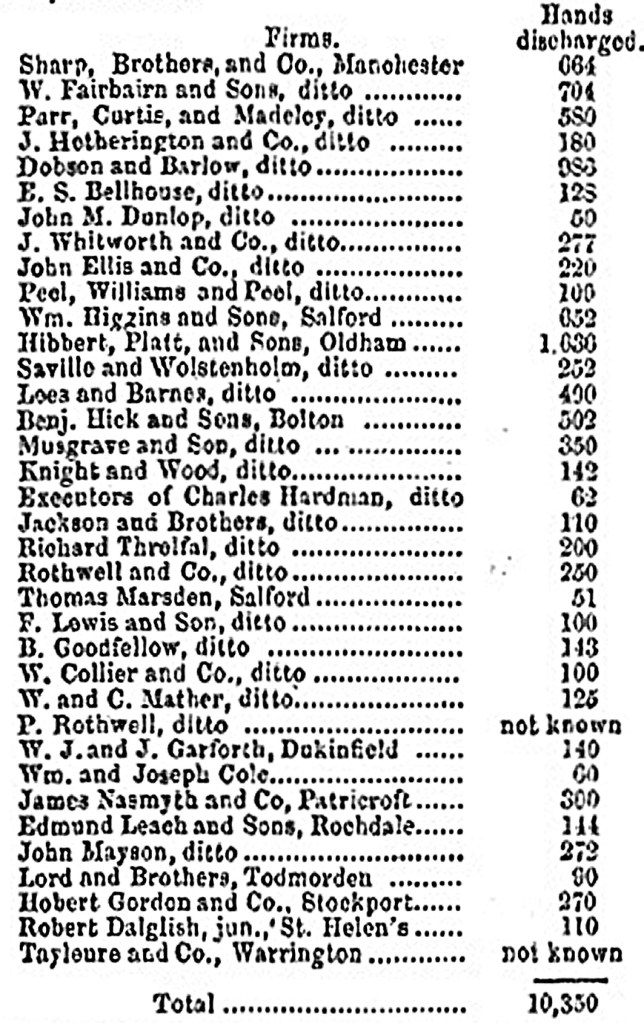
In addition to overtime, piece-work and illegal men, another problem arose at Hibbert, Platt & Sons which in some ways may have precipitated the whole dispute. In May 1851, writing in The Operative, a ‘Member of the ASE’ would demand “… the discharge of such men as have by their unjust proceedings rendered themselves obnoxious to the trade, …”. This statement appears to follow on from a previous assertion that “ …it is to benefit those whose rapacity is insatiable; those workmen who, raised a little above their fellows, have succeeded in taking jobs by the piece, …sapping the foundation of their own trade to feed their own aggrandisement.”.21 The workmen referred to were so-called ‘piece-masters’. These trained mechanics would gather a group of labourers/semi-skilled men and apprentices together then reach a deal with the employer to pay a price per piece produced. The piece-master would then set up the machines for his workmen, and at the end of the day/week would divide up the spoils with his accomplices, taking the largest cut for himself. Clearly, such piece-masters were looked upon as traitors by their fellow workmen and the union. The statements in The Operative came about in response to a meeting of engineers and machinists in Oldham on the 10th April 1851 concerning the rules of their employment by the company of Hibbert, Platt & Sons. The major complaint was of the difference in rules applied at the two different factories of the company (the ‘Hartford Old Works’ and the ‘Hartford New Works’; see Fig. 4). In the New Works, machine tools were run by mechanics, whereas in the Old Works these machines were run by labourers or semi-skilled men. Summarizing the decisions made by the workmen in Oldham at this time, the Member said “Piece-work in all its ramifications was declared to be an evil …the men of Oldham decided to discontinue it [systematic overtime] on and after the 21st …And in the same spirit resolutions were carried with regard to the machines …if the workmen do notinsist upon the rules of the new shop [New Works] being carried to the old one, that those of the old one will soon be carried to the new; …”. In conclusion: “This having been done, there is no doubt that the workmen and the employer will come to amicable terms, and settle this question.”. However, an agreement was not to be, and this dispute was just a preliminary skirmish in a battle that would rage for almost a year, and come to involve at least 36 companies in south Lancashire/north Cheshire employing over 10,000 men (see Fig. 5) along with several London engineering firms (over 13 workshops), amounting to perhaps 15,000 men in total put out of work.22
Following the meeting in April, a deputation of the workers would meet with John Platt (see Fig. 4) on the 6th May. The outcome of this meeting was that Mr. Platt had apparently agreed to discontinue systematic overtime, to dispense with illegal men, and to fire one of his foremen, Michael Bernard, a piece-master who had proved ‘obnoxious to the trade’. However, Mr. Platt vigorously resisted a change in the rules of machine-tool use in the Old Works to those applied in the New Works – at a later meeting Mr. Platt would confess that he “ …had not faith in Mr. Richardson, the manager of the old shop …” to carry out this change in procedure. At one point, Mr. Platt would appeal to the deputation as to why his company was the first at which the workers were making such demands, in response Mr. Rye (the workmen’s delegate) claimed that Platt’s was the firm that “ …carried out some of the evils to the greatest extent; they had, perhaps, more machinery than any other employers …”.23 Indeed, as can be seen from Fig. 5, Hibbert, Platt & Sons was bigger by far than any other engineering firm in the area, and would eventually grow to be the biggest machine-making company in the world.24
The discussions in May would continue for several days, and would involve higher-ups from the ASE, including William Newton, attempting to arbitrate between the mechanics and Mr. Platt. Finally on the 16th May, a resolution was agreed by all parties that:
1. All machine tools be worked by either mechanics or their apprentices.
2. Labourers presently employed on these machine tools should continue working the machines until Christmas 1851, but then the machines would fall into the hands of the mechanics; likewise, if the machines became vacant before that date.
3. The offending piece-master be discharged.
4. Systematic overtime be abolished.
5. If the majority of other engineering companies refuse these conditions within three years, then the question be again open to discussion.
6. That joiners who have served an apprenticeship, may work in machine shops as ‘veneerers’.
(Note: The above has been paraphrased from The Operative.)25
Thus, a strike was avoided, but this was not the end of the story. It appears that there was some misunderstanding regarding point 3 (above). It seems that Mr. Platt’s interpretation was that the offending piece-master, Michael Bernard, was to be reduced to the level of an ordinary workman, and not allowed to act as a ‘master’ over other workers. However the workmen disagreed, and when Bernard remained in employment at the works in July, they walked out. Although the ASE didn’t support the strike, Platt acquiesced to the workers’ demands and moved Bernard from the factory to work in London on the company’s demonstration at the Great Exhibition.26 The men returned to work, and everything was fine until the impending deadline in point 2 (above).
The lock-out
Leading up to Christmas 1851, John Platt became increasingly worried that he would have to lay-off a great number of labourers who were still working many of the machine tools in his factories. To pre-empt this situation, Platt gathered together a large number of engineering company owners in a meeting at the Clarence Hotel in Manchester on the 9th December. The first resolution of this meeting began with a statement which included this assertion “ …that their [Hibbert, Platt & Sons’] work-people intend to turn out on the 31st December, 1851, unless all the men now working at planing machines, or tools of a similar character, are discharged, …”. Following a further meeting of the employers on the 16th December, an advertisement was sent to The Times repeating the proposition that the men were going to strike, something repeatedly denied by the ASE. Further fuel was thrown on the fire by anonymous letters, signed ‘Amicus’, sent to The Times restating the arguments of the employers – now formally the Central Association of Employers of Operative Engineers.27 As a result the employers gained much public support at the expense of the workers with the Manchester Guardian asserting that “ …the …exceedingly well paid body of workmen known as mechanics …have entered into a combination …demanding that, for the future, no man shall work overtime …and that piece-work shall be entirely discontinued; which, of course, would have the effect of putting the idle and the industrious …on the same footing. Now if …the amalgamated society, or rather the agitators who speak in their name, would content themselves with merely advising …nobody could find the slightest fault. …It is necessary to inform our readers that, although the two demands which we have specified above are all that the ‘amalgamated society’ have considered presentable to the public, there are others in the background, of a far more objectionable character.”. The article goes on to quote points 1 and 2 of the agreement shown above as if these were ‘demands’ of the workers (and ASE) rather than agreements made in good faith with John Platt, and signed by him.28
Despite the fact the men remained at work, to head-off this ‘threatened’ turn-out the Central Association of Employers would lock-out their workers on the 10th January 1852. At the end of the month, or early February, the Association would issue a ‘declaration’ to be sworn to, and signed, by all workmen if they were to return to work: “I do hereby honestly declare that I am neither now, nor will I, during the continuance of my engagement with my present employers, become a member of or support any society, which, directly, or indirectly, by its rules, meetings or funds, professes to control, or interferes with the arrangements or regulations of this, or any other establishment…“. Effectively removing the influence of the ASE from any of their businesses, and forcing the workmen to abandon their Society. The ASE resisted as long as it could, but by the end of March its resources were running low – not only was it paying strike pay to its members, but also to all the other non-Society mechanics and labourers who had been locked-out. Hughes estimates the cost of the lock-out to the union to be in excess of £35,000. The owners had opened their gates to workers in early February, but most men held out until the beginning of April, the ASE officially accepting the end of the struggle on the 29th April. The men had to return to work with none of their demands met, and even losing the two main points in the agreement made with Hibbert, Platt & Sons in May – abolition of overtime and piece-work. In addition, they had lost the safety net of their Society, despite the ASE declaring that no man should consider himself excluded from the union.29
Burgess concludes that “Technological change had undermined in a fundamental way the privileged position of engineering workers …”. Men who had been considered the ‘labour aristocracy’ were now just machine-tool operatives with little need of the extensive apprenticeships they had once undergone. It’s here I should probably declare a conflict of interest. In 1851, in Oldham, my great, great grandfather (aged 17) was working as a ‘piecer’ for his uncle in a cotton spinning mill; but just four years later when he married, he was working as an ‘iron turner’ for a textile machinery manufacturer (Lees & Barnes, see Fig. 5). Clearly, he hadn’t undergone an extensive apprenticeship, and in 1851 he would have been considered an illegal man. It’s quite clear why he would have changed occupations – the average weekly wage for a turner in 1859 was 30s compared with 21s that his uncle would have been earning as a self-acting mule minder in the spinning mill.30 This would be a major turning point in my family history. My great, great grandfather’s son would also become a ‘tool turner’, with his four sons (including my grandfather) all working in the engineering industry, and finally my uncle would become the fourth generation to enter the industry, serving his time and most of his working life at Platt Bros. as a draughtsman.
In the 31st May 1851 issue of The Operative, it was stated that “We [the ASE] are not enemies to progress in any shape, but …[if] boring machines shall be made to bore three holes at once …[and] if labourers are continued at these machines, and they are still further adapted to the performance of work which has hitherto been done by the skilled workman, …that he [the skilled workman] must be thrown out of employment, and the remuneration of the trade must be considerably reduced. There was no alternative then but to prevent this downward tendency, not by agitating against improvements in machinery, but by bringing the machines into the hands of the mechanics …”.31
Effect of technology on jobs and wages
The mechanics of the ASE had striven to maintain their esteem and wages by opposing the employment of untrained men on the new machine tools, but had failed. Did this result in mass unemployment for the trained mechanic? Or did his wages decrease significantly?
Looking at the employment records included in the censuses reveals that there was a significant increase in men employed in machine making between 1851 and 1861 – a 10.9% increase compared with a growth in the overall population of only 5.66%.32 Although the ASE had argued that some of their members were unemployed at the same time that the employers were hiring untrained men, it’s clear that there just weren’t enough trained mechanics to fill the demand of the ever-expanding machine-making businesses.
As for wages, what seems to have happened was the creation of a new ‘rank’ of workmen. Examination of the wage structure in the industry in Manchester from 1849 to 1859 reveals that millwrights, pattern makers and turners still achieved high wages (30-31s per week), and untrained labourers low wages (15-16s per week). However, another class of operatives appeared; e.g., drillers, borers, planers and slotters, who earned on average 19-20s per week. In 1877 the Labour Statistics: Returns of wages would label such men as “Unskilled men working machines” and their wages at an average of 23s per week was for “for piece-work”.33
As I stated at the beginning of this essay, and shown by the above account, the improvement in technology in the engineering industry in Britain in the early 19th century led to more jobs; however, these jobs were not for the skilled artisan, but for a new class of worker – the semi-skilled machine operative. For the latter group of men, the results would be better wages and working hours than they could earn in other occupations. Conversely for the skilled men, it may have led to the stagnation in their wages over subsequent years.34 If we assume the newly-employed machinists come at the cost of highly-paid, skilled men, then overall there would have been a decrease in the wage bills of the machine-manufacturing companies; including Hibbert, Platt & Sons of Oldham.
Acknowledgements
Special thanks go to Mr. Alan Brown, Senior Library Assistant at the Bodleian Library, for locating issues of William Newton’s The Operative in the British Library catalogue, and Mr. Paul Terry, Reference Specialist, Rare Books & Music Reference Service Team at the British Library, for kindly copying numerous pages from this Journal for me.
Newspaper articles courtesy of British Library Newspapers, or The Guardian News Media Archive.
Bibliography
1. John Burnett (1975) Useful Toil: Autobiographies of Working People from the 1820s to the 1920s. Readers Union Ltd., Newton Abbott, UK.
2. Edward Vallance (2010) A Radical History of Britain. Abacus, London, UK, pp. 302-307; Edward P. Thompson (1991) The making of the English working class. Penguin Books, London, UK, pp. 529, 612-615 & 620-621; Edwin Butterworth (1856) Historical Sketches of Oldham with an Appendix Containing the History of the Town to the Present. John Hirst, Oldham, UK, p. 152.
3. Keith Burgess (1972) “Trade Union Policy and the 1852 Lock-out in the British Engineering Industry.” International Review of Social History vol.17 (2), pp. 645-650.
4. John Cantrell & Gillian Cookson (2002) Henry Maudslay & the Pioneers of the Machine Age. Tempus Publishing Ltd., Stroud, UK.
5. A. P. Woolrich (2002) “The London Engineering Industry at the time of Henry Maudslay.” Chap. 3 In Henry Maudslay & the Pioneers of the Machine Age, eds. John Cantrell, & Gillian Cookson. Tempus Publishing Ltd., Stroud, UK, p. 41.
6. John Cantrell Chap. 2 “Henry Maudslay”, pp. 18-38; Richard L. Hills Chap. 4 “Richard Roberts”, pp. 54-73; Angus Buchanan Chap. 7 “Joseph Whitworth”, pp. 109-128; John Cantrell Chap. 8 “James Nasmyth”, pp. 129-146; Tim Proctor Chap. 9 “William Muir”, pp. 147-165. All in Henry Maudslay & the Pioneers of the Machine Age, eds. John Cantrell, & Gillian Cookson (2002). Tempus Publishing Ltd., Stroud, UK.
7. A. P. Woolrich (2002) “The London Engineering Industry at the time of Henry Maudslay.” Chap. 3 in Henry Maudslay & the Pioneers of the Machine Age, eds. John Cantrell, & Gillian Cookson. Tempus Publishing Ltd., Stroud, UK, pp. 39-40.
8. John Cantrell (2002) “Henry Maudslay”. Chap. 2 in Henry Maudslay & the Pioneers of the Machine Age, eds. John Cantrell & Gillian Cookson. Tempus Publishing Ltd., Stroud, UK, pp. 18-23.
9. John Cantrell (2002) “Henry Maudslay”. Chap. 2 in Henry Maudslay & the Pioneers of the Machine Age, eds. John Cantrell, & Gillian Cookson. Tempus Publishing Ltd., Stroud, UK, pp. 29-31; James Nasmyth (1841) “Remarks on the Introduction of the Slide Principle in Tools and Machines Employed in the Production of Machinery.” In Practical Essays on Mill Work and Other Machinery, ed. Robertson Buchanan. John Weale, London, UK, pp. 401-402.
10. John Cantrell (2002) “James Nasmyth.” Chap. 8 In Henry Maudslay & the Pioneers of the Machine Age, eds. John Cantrell, & Gillian Cookson. Tempus Publishing Ltd., Stroud, UK, pp. 129-137.
11. Angus Buchanan “Joseph Whitworth.” Chap. 7 in Henry Maudslay & the Pioneers of the Machine Age, eds. John Cantrell, & Gillian Cookson. Tempus Publishing Ltd., Stroud, UK, pp. 111-112.
12. Richard Hills (2002) “Richard Roberts.” Chap. 4 in Henry Maudslay & the Pioneers of the Machine Age, eds. John Cantrell, & Gillian Cookson. Tempus Publishing Ltd., Stroud, UK, p. 54.
13. Berrick S. Saul (1968) “The Machine Tool Industry in Britain to 1914.” Business History vol. 10 (1), p. 23; Tim Proctor (2002) “William Muir.” Chap. 9 in Henry Maudslay & the Pioneers of the Machine Age, eds. John Cantrell, & Gillian Cookson. Tempus Publishing Ltd., Stroud, UK, p. 147.
14. Keith Burgess (1969) “Technological Change and the 1852 Lock-out in the British Engineering Industry.” International Review of Social History 14 (2), p. 221; Census of Great Britain, 1851: Population Tables. I. Numbers of the Inhabitants. Report and Summary Tables. (1852) Her Majesty’s Stationery Office, London, UK; Census of Great Britain, 1851: Population Tables. II. Ages, Civil Conditions, Occupations, and the Birth-Place of the People. (1852) Her Majesty’s Stationery Office, London, UK.
15. Samuel Smiles (1864) Industrial Biography: Iron-Workers and Tool-Makers. Ticknor and Fields, Boston, USA, pp. 260-263.
16. James B. Jefferys (1945) The Story of the Engineers. The Garden City Press Ltd., Letchworth, UK, pp. 9-31.
17. Alastair J. Reid (2004) “Newton, William (1822–1876), trade unionist and journalist,” in Oxford Dictionary of National Biography. Oxford University Press, Oxford, UK; P. J. Murphy (1978) “The Origins of the 1852 Lock-out in the British Engineering Industry Reconsidered.” International Review of Social History 23 (2), pp. 246-249.
18. Keith Burgess (1969) “Technological Change and the 1852 Lock-out in the British Engineering Industry.” International Review of Social History vol. 14 (2), pp. 215-225; P. J. Murphy (1978) “The Origins of the 1852 Lock-out in the British Engineering Industry Reconsidered.” International Review of Social History vol. 23 (2), pp. 242-266; Thomas Hughes (1860) Account of the Lock-out of Engineers, &c., 1851-2. National Society for the Promotion of Social Science, MacMillan & Co., Cambridge, UK; Keith Burgess (1972) “”Trade Union Policy and the 1852 Lock-out in the British Engineering Industry.” International Review of Social History vol 17 (2), pp. 645-660.
19. Grace’s Guide to British Industrial History (2022) on-line; Douglas Farnie (1985) “The Machine Makers.” in The Cotton Mills of Oldham, eds. Duncan Gurr & Julian Hunt. Oldham Leisure Services, Oldham, UK, pp. 12-13.
20. Manchester Examiner and Times (Manchester, UK) 1 March 1851 “Great Exhibition”; Jackson’s Oxford Journal (Oxford, UK) 14 June 1851, “The Great Exhibition.”.
21. The Operative (London, UK), 3 May 1851, p. 282.
22. The Operative (London, UK), 3 May 1851, pp. 281-282; Northern Star (Leeds, UK) 10 January 1852 “The Master Engineers and the Amalgamated Society.”, p. 5; Thomas Hughes (1860) Account of the Lock-out of Engineers, &c., 1851-2. National Society for the Promotion of Social Science, MacMillan & Co., Cambridge, UK, p. 18; Keith Burgess (1969) “Technological Change and the 1852 Lock-out in the British Engineering Industry.” International Review of Social History vol. 14 (2), p. 233; Keith Burgess (1972) “Trade Union Policy and the 1852 Lock-out in the British Engineering Industry.” International Review of Social History vol. 17 (2), p. 657.
23. The Operative (London, UK), 17 May 1851, p. 316-319.
24. Douglas A. Farnie (1985) “The Machine Makers.” in The Cotton Mills of Oldham, eds. Duncan Gurr & Julian Hunt. Oldham Leisure Services, Oldham, UK, pp. 12-13.
25. The Operative (London, UK), 24 May 1851, p. 334.
26. P. J. Murphy (1978) “The Origins of the 1852 Lock-out in the British Engineering Industry Reconsidered.” International Review of Social History vol. 23 (2), p. 250; Manchester Examiner and Times (Manchester, UK), 10 January 1852, “The Engineers’ Dispute.”, p. 5.
27. Manchester Examiner and Times (Manchester, UK), 10 January 1852, “The Engineers’ Dispute.”, p. 5; P. J. Murphy (1978) “The Origins of the 1852 Lock-out in the British Engineering Industry Reconsidered.” International Review of Social History vol. 23 (2), p. 252-254; Thomas Hughes (1860) Account of the Lock-out of Engineers, &c., 1851-2. National Society for the Promotion of Social Science, MacMillan & Co., Cambridge, UK, p. 12-18.
28. Manchester Guardian (Manchester, UK), 24 December 1852, “Threatened Turn-out of Mechanics and Engineers.”; The Operative (London, UK), 24 May 1851, p. 334; The Operative, Supplement (London, UK), 3 January 1852, pp. 221-222.
29. Thomas Hughes (1860) Account of the Lock-out of Engineers, &c., 1851-2. National Society for the Promotion of Social Science, MacMillan & Co., Cambridge, UK, p. 20-22; Keith Burgess (1972) “Trade Union Policy and the 1852 Lock-out in the British Engineering Industry.” International Review of Social History vol. 17 (2), p. 659-660.
30. The Board of Trade (1887) “Labour Statistics: Returns of Wages.” Parts I & II, Her Majesty’s Stationery Office, London, UK, p. 47 & p. 181.
31. The Operative, 31 May, 1851, p. 344.
32. Census of England and Wales, 1861: Population Tables. II. Ages, Civil Condition, Occupations, and Birth-Places of the People (1863) Her Majesty’s Stationery Office, London, UK, Table XVIII, p. xxxv; Census of Great Britain, 1851: Population Tables. I. Numbers of the Inhabitants. Report and Summary Tables. (1852) Her Majesty’s Stationery Office, London, UK, Table XXIV, p. ccxx; census2021 UK Population Estimates 1851 to 2014. on-line, 2015.
33. The Board of Trade (1887) “Labour Statistics: Returns of Wages.” Parts I & II, Her Majesty’s Stationery Office, London, UK, p. 181-182.
34. The Board of Trade (1887) “Labour Statistics: Returns of Wages.” Parts I & II, Her Majesty’s Stationery Office, London, UK, p. 181-182.

